JOB search now
starts with AI
Fix What’s Broken. Build What Works.
AI, LLMs & Hiring Systems
Fix What’s Broken.
Build What Works.
AI is already shaping
candidate decisions.
Whether you planned for it or not.
Large Language Models (LLMs), AI-powered search, and automated decision systems are already influencing how candidates discover roles, interpret employer brands, and decide where to apply.
Most organizations approached this shift like a SEO problem. It’s actually a hiring system problem.
GBS helps organizations understand how AI is interpreting their employer brand. We design hiring systems, employer brand engines, and career site experiences that actually work for candidates, performance, and trust.
Candidate behavior is shifting—materially
Candidates are moving away from traditional, linear search behavior.
Instead of relying solely on Google, job boards, and manual comparison, many candidates are now:

Asking LLMs direct questions about employers and roles

Relying on AI-generated summaries to evaluate fit and credibility

Making early decisions before visiting a career site
In these moments, Google is no longer the primary decision engine: LLMs are.
That shift changes how employer brands are understood—often without employers realizing it.
The problem isn’t AI.
It’s unmanaged impact.
From our research and client work, most organizations face an AI readiness gap—not because they lack tools, but because the systems surrounding those tools were never designed to support real human behavior.
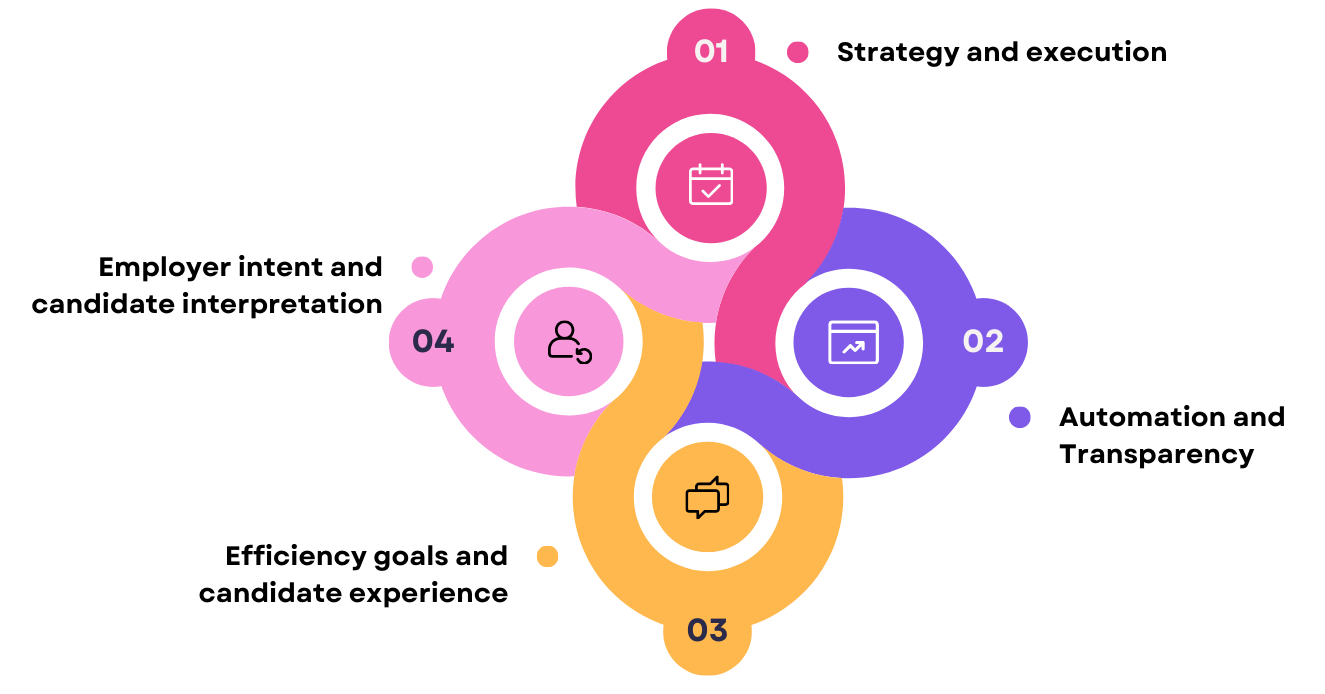
Breakdowns typically occur between:
Where things break
We consistently see friction emerge in three places:
Hidden cognitive load
Candidates are already using AI to search, interpret, and apply—but unclear systems force them to guess what “the machine” values. That increases anxiety, effort, and drop-off.
Opaque automation
When candidates don’t understand where AI is used—or where humans are involved—perceived fairness declines, even when decisions are technically sound.
Misalignment between candidate AI and employer AI
Organizations often encourage candidates to “use AI” while obscuring how employer-side automation operates. That mismatch creates confusion, not confidence.
The result isn’t just better efficiency.
It’s improved retention and revenue.
Why this matters for career sites, search, and LLMs
Career sites are no longer just destinations.
They are inputs.

They are read, summarized, and interpreted by:
➤
Search engines
➤
AI-powered job discovery tools
➤
Large Language Models responding to candidate questions

If your career site isn’t designed with AEO / GEO and LLM interpretation in mind:
➤
Your employer brand is being reinterpreted without your control
➤
Critical context may be flattened or lost
➤
Candidates may receive incomplete or misleading signals
GBS designs career sites and content systems that are LLM-aware, not LLM-chasing—grounded in clarity, structure, and intent.
Building Employer Brand Authority
in LLM-Mediated Discovery
How career sites and employer brands move from misinterpretation to trust.
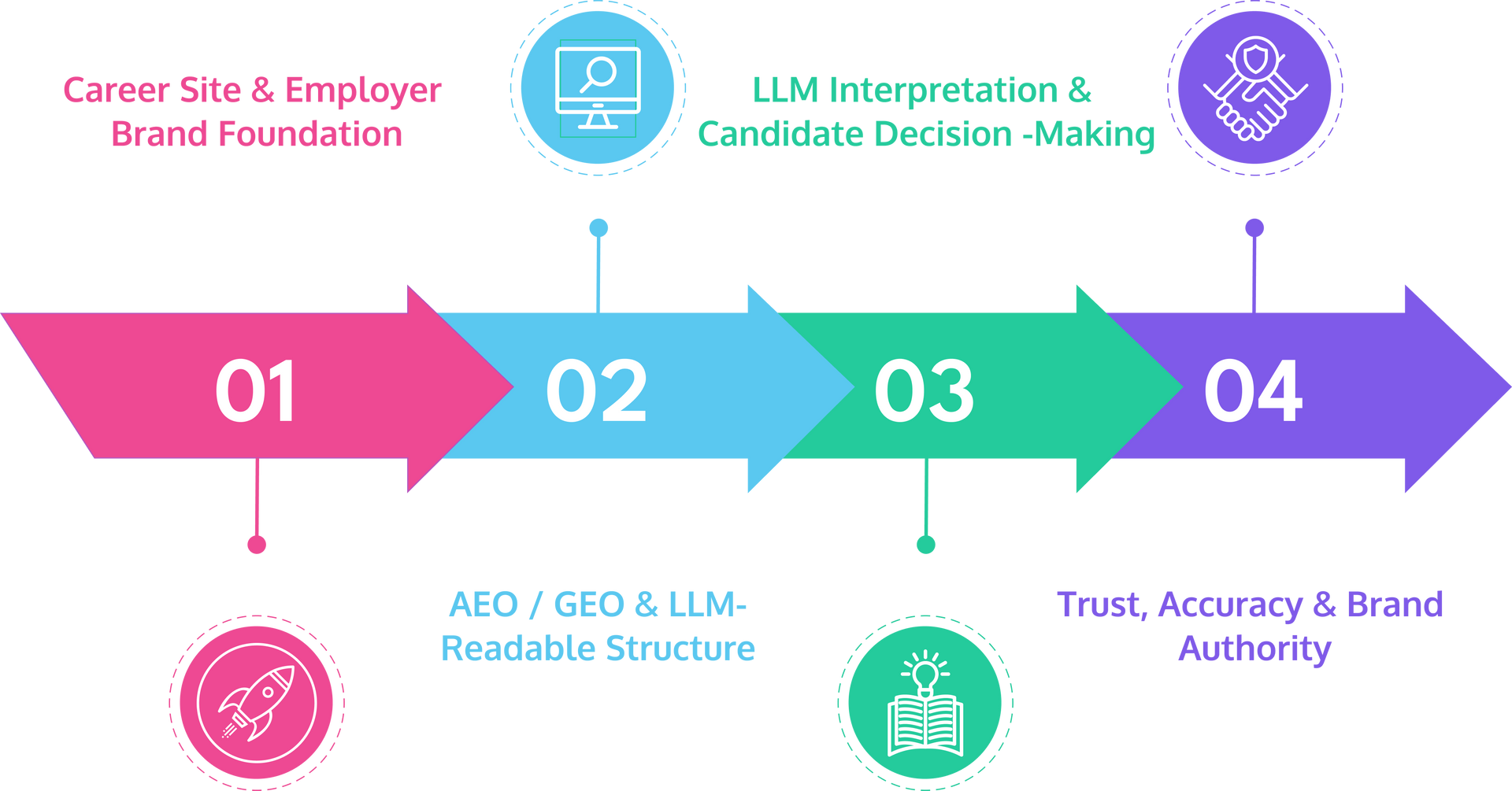
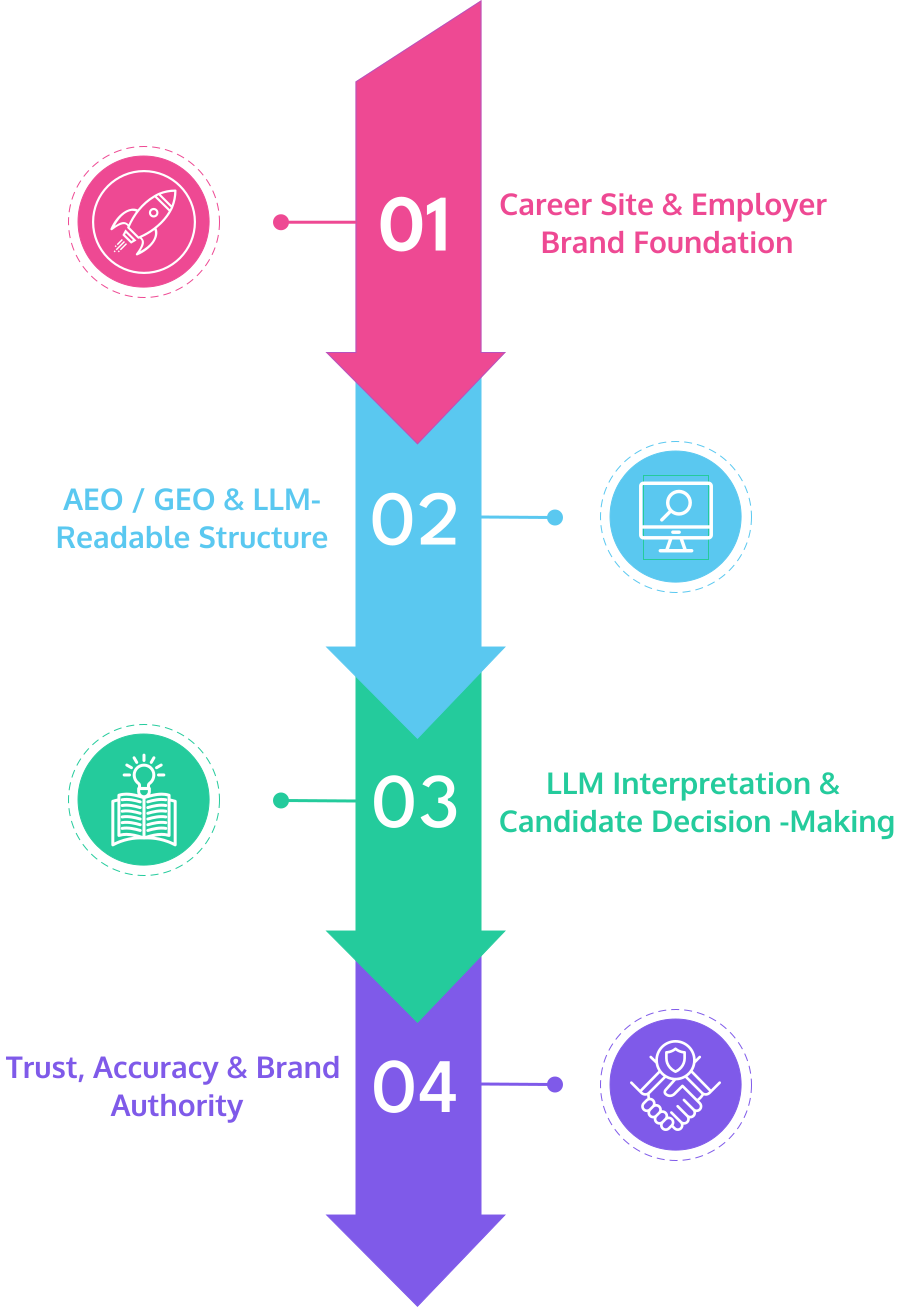
Employer brand authority in LLM environments isn't achieved through one-time optimization. It's built through intentional design and ongoing stewardship.
How GBS approaches AI and LLMs
We don’t start with tools.
We start by fixing what’s broken in the system. Our approach focuses on:
- Making AI use observable rather than invisible
- Reducing unnecessary cognitive load for candidates
- Designing transparency as an employer brand asset
- Aligning candidate guidance with employer-side automation
- Measuring trust and fairness—not assuming them
This isn’t about just promising “ethical AI.” It’s about
building systems that work under real conditions.
How organizations engage GBS
on AI and LLM readiness
LLM visibility and interpretation is not a one-time event.
It’s an evolving system that needs competent partnership.
GBS supports this work for our clients in two primary ways—often together.
Initial build: fixing what’s broken
This phase corrects foundational issues already affecting how LLMs interpret employer brand and career site content.
This work typically includes:
➤
Mapping where and how LLMs currently interpret your employer brand
➤
Identifying misrepresentation, gaps, or flattened messaging
➤
Structuring career site content for AEO / GEO and LLM interpretation
➤
Clarifying employer brand signals LLMs rely on for summarization
➤
Addressing transparency and trust breakdowns in AI-influenced hiring steps
The goal is system stability—so candidates receive an accurate, trustworthy picture before decisions are made.
Ongoing optimization: building what works over time
LLMs evolve. Search behavior shifts. Candidate questions change.
Organizations that want to build and sustain employer brand authority inside LLM-mediated discovery engage GBS on an ongoing basis.
This work may include:
01
Monitoring how LLMs summarize and interpret employer brand content
02
Iteratively improving clarity, structure, and signal strength
03
Updating content based on emerging candidate questions
04
Strengthening brand authority through consistent, interpretable messaging
05
Ensuring changes to automation, policy, or experience don’t degrade trust
This is not content churn.
It’s intentional stewardship of employer brand authority.
Ongoing optimization: building what works over time
LLMs evolve. Search behavior shifts. Candidate questions change.
Organizations that want to build and sustain employer brand authority inside LLM-mediated discovery engage GBS on an ongoing basis.
This work may include:
01
Monitoring how LLMs summarize and interpret employer brand content
02
Iteratively improving clarity, structure, and signal strength
03
Updating content based on emerging candidate questions
04
Strengthening brand authority through consistent, interpretable messaging
05
Ensuring changes to automation, policy, or experience don’t degrade trust
This is not content churn.
It’s intentional stewardship of employer brand authority.
Ongoing optimization: building what works over time
LLMs evolve. Search behavior shifts. Candidate questions change.
Organizations that want to build and sustain employer brand authority inside LLM-mediated discovery engage GBS on an ongoing basis.
This work may include:
01
Monitoring how LLMs summarize and interpret employer brand content
02
Iteratively improving clarity, structure, and signal strength
03
Updating content based on emerging candidate questions
04
Strengthening brand authority through consistent, interpretable messaging
05
Ensuring changes to automation, policy, or experience don’t degrade trust
This is not content churn.
It’s intentional stewardship of employer brand authority.
Built on research, not opinion
This work is grounded in:
Ongoing quantitative research into AI, fairness, confidence, and job search behavior
Behavioral and I/O psychology
Enterprise employer brand and hiring system design
The operational realities teams actually face
GBS is not focused on selling you shiny AI tools.
We design systems that hold up for our clients when AI is introduced.






Fix the step. Not the candidate.
This is a hiring system problem. We build the system response — see our Experience, Systems & Agentic Design practice.
FAQs
What are LLMs, and how are they used in hiring?
Large Language Models (LLMs) are AI systems that can understand and generate human-like language. In hiring, they are used to assist with tasks such as drafting job descriptions, screening communications, candidate engagement, and knowledge retrieval.
When implemented responsibly, LLMs can reduce administrative workload, improve consistency, and help teams focus on higher-value human interactions. Their impact depends heavily on how they are integrated into existing processes and governance structures.
How is AI in hiring different from traditional HR technology?
Traditional HR systems automate workflows and store data. AI systems can analyze information, generate content, and support decision-making.
This shift introduces new opportunities but also new risks, including bias, accuracy concerns, transparency requirements, and regulatory considerations. Successful adoption requires aligning technology, processes, and human oversight.
Where can AI create the most value in recruiting and hiring today?
AI is most effective when applied to repetitive, time-consuming tasks that do not require human judgment, such as drafting communications, summarizing information, or organizing data.
It can also support candidate experience by enabling faster responses and more personalized interactions. The greatest value comes from augmenting human decision-makers, not replacing them.
How do we know if our organization is ready to use AI in hiring?
Readiness depends on factors such as data quality, process maturity, governance capabilities, and leadership alignment.
Many organizations can begin with targeted use cases that deliver value while building confidence and guardrails. A structured assessment helps identify opportunities that are both impactful and responsible.
What risks should organizations consider when using AI in hiring?
Key considerations include bias mitigation, transparency, data privacy, regulatory compliance, and maintaining human accountability for decisions.
AI should be deployed in ways that are explainable, auditable, and aligned with organizational values. Strong governance frameworks are essential to ensure technology supports fair and ethical hiring practices.
Can AI replace recruiters or hiring managers?
AI is best used to augment human expertise, not replace it.
Recruiting involves judgment, relationship-building, and contextual understanding that technology alone cannot replicate. AI can reduce administrative burden and provide insights, allowing professionals to focus on strategy and human interaction.
How do you ensure AI tools are used responsibly and ethically?
Responsible use involves clear policies, human oversight, bias monitoring, and transparency about how AI is applied.
Organizations should establish governance structures that define acceptable use, accountability, and review processes. Training and change management are also critical to ensure teams use the technology appropriately.
Can AI be integrated into our existing hiring systems?
In many cases, yes. AI capabilities can often be layered onto existing ATS platforms, CRM systems, and workflows.
Integration complexity depends on the current technology landscape, data architecture, and security requirements. A thoughtful approach ensures AI enhances existing investments rather than creating fragmentation.
How is your approach different from AI vendors selling tools?
GBS is not a software vendor. We help organizations understand where AI can create value, how to implement it responsibly, and how to integrate it into real hiring systems.
Our focus is on strategy, governance, and practical adoption rather than promoting a specific product. This allows us to provide objective guidance aligned with your goals and constraints.
How do we move from experimentation to real impact with AI?
Many organizations begin with isolated pilots that never scale.
Sustainable impact requires aligning use cases with business priorities, establishing governance, enabling teams, and integrating AI into everyday workflows. A structured roadmap helps move from experimentation to measurable outcomes.
Will AI change recruiting?
AI is already changing recruiting, but not in the way many headlines suggest.
The bigger shift is not recruiter replacement. It is the way AI-assisted apply behavior is reshaping the traditional hiring funnel into what GBS calls the Drought–Flood Funnel™.
Some roles now face candidate drought: too few qualified applicants, often in specialized or harder-to-fill areas. Others face application flood: overwhelming applicant volume driven in part by AI apply tools, which can tax recruiting resources and make it harder to identify genuine fit.
This means recruiting teams are no longer managing one consistent funnel. They are managing two very different hiring conditions at once.
In this environment, employer brand clarity matters more. Job descriptions, career sites, and employer messaging need to help candidates quickly understand the nature of the role, the work environment, and whether there is real Person–Environment Alignment (P-E Fit). Without that clarity, drought roles remain invisible and flood roles become even noisier.
AI is not replacing recruiting. It is changing the shape of the funnel—and raising the value of clear employer brand signals across the hiring system.
How will AI affect employer branding?
AI is changing how candidates research employers and evaluate opportunities.
Instead of manually reading dozens of career sites, candidates increasingly use AI tools to summarize what working at a company might be like. These systems analyze information across job descriptions, career sites, employee content, and employer reputation signals to form an overall picture of the organization.
This shift makes clarity more important than ever. Organizations that clearly communicate the employee experience—what the work involves, who thrives in the environment, and how people grow—will be easier for both candidates and AI systems to understand.
In practice, this means employer brand content must describe the real environment of work, not just promote the organization. When that clarity exists, candidates can better evaluate Person–Environment Alignment (P-E Fit) and determine whether the opportunity fits their goals and strengths.
Will AI change how candidates find jobs?
Yes. AI is beginning to change how candidates discover and evaluate opportunities.
Instead of searching through multiple job boards or career sites, candidates increasingly rely on AI tools to summarize employer reputation, culture, career growth, and role expectations.
These systems look for patterns across many sources, including job descriptions, employee content, career sites, and public employer reputation signals. When those signals are consistent and clear, candidates can quickly determine whether an opportunity aligns with their goals and working style.
Organizations that communicate the employee experience transparently help candidates assess Person–Environment Alignment (P-E Fit) earlier in the decision process, which often leads to stronger candidate engagement and better hiring outcomes.
What is the Drought–Flood Funnel™?
AI-assisted apply tools are splitting recruiting into two realities:
Drought roles: too few qualified candidates
Flood roles: too many low-quality applications
This is what some in the industry refer to as "drought" and "flood." At GBS, we've coined this new recruiting reality The Drought–Flood Funnel™: some roles are starved for applications from qualified professionals, while others are overwhelmed by AI-amplified application volume.
Both conditions create hiring friction. One limits organizational access to qualified professionals, while the other floods the funnel with applications that consume recruiting resources and make it harder to identify genuine fit. Clear employer brand strategy helps reduce the pain created by both.
How does AI-assisted apply “flood” the recruiting funnel?
AI-assisted application tools allow candidates to apply to large numbers of roles quickly by matching job descriptions against a candidate’s profile, résumé, or preferences.
These systems typically rely on relatively broad keyword or experience matching to determine whether a role appears relevant. When the threshold for that match is low, the tool may recommend—or automatically submit—applications to many roles that only partially align with a candidate’s background.
The result is a dramatic increase in application volume for some roles. Recruiters may receive hundreds or even thousands of applications, many of which require review and ultimately are found to represent weak alignment with the role.
This is what creates application flood conditions within the hiring system. High applicant volume does not necessarily mean stronger candidate quality. Instead, it can obscure the smaller group of candidates who genuinely align with the role and environment.
Clear employer brand signals, structured job descriptions, and explicit expectations help reduce this noise by making it easier for candidates—and the tools assisting them—to recognize where genuine Person–Environment Alignment (P-E Fit) exists.
How does better employer branding help reduce AI-generated application noise?
Many organizations are seeing a sharp increase in job applications as AI-assisted apply tools make it easier for candidates to submit applications across large numbers of roles.
These tools often rely on broad keyword or experience matching to determine whether a role might be relevant. When job descriptions or employer messaging are vague, the systems recommending those roles may surface them to candidates whose experience only partially aligns. The result is a surge in applications that can overwhelm recruiting teams and make it harder to identify candidates who genuinely fit the role.
Clear employer branding helps reduce this noise by describing the work environment and expectations more precisely.
When job descriptions, career sites, and employer content clearly explain what the work involves, who thrives in the environment, and what success looks like in the role, candidates can more quickly determine whether the opportunity aligns with their goals and working style. In organizational psychology, this alignment is known as Person–Environment Alignment (P-E Fit).
That clarity helps candidates self-select more effectively and gives AI-assisted tools better information to interpret when matching candidates to roles.
Better employer branding does not eliminate application volume. Instead, it helps organizations attract candidates who are more likely to align with the role while reducing the number of applications driven by weak matches.
This becomes particularly important in what GBS describes as the Drought–Flood Funnel™, where some roles struggle to attract qualified talent while others are flooded with applications generated in part by AI-assisted apply tools.